Twin Double Pendulums is more chaotic than my other engine using 2 Lorenz.
This is more suited for Oriental music like Koto.
The pendulums are released from the same angle, one of them
offset by a ten-thousandth of a degree. Both drive a lead voice. While the
runs agree the two voices land on the same note, so you hear a single line
over a rolled arpeggio. As the gap opens the twin becomes a real second
voice, chords swell in behind it, and once the runs have parted for good the
whole band is in.
Nothing is pre-recorded and nothing loops. Every release is new.
THE SONG FORM IS THE PHYSICS
There is no bar counter and no scripted arrangement — the piece is however
long the pendulums stay together. Their separation is the structure:
IN SYNC — lead and twin on the same note, one line over an arpeggio that
re-voices itself every bar.
DRIFTING — the twin splits into real intervals; chords enter and swell.
DIVERGED — bass enters, the grooves open up, the mood engine wakes.
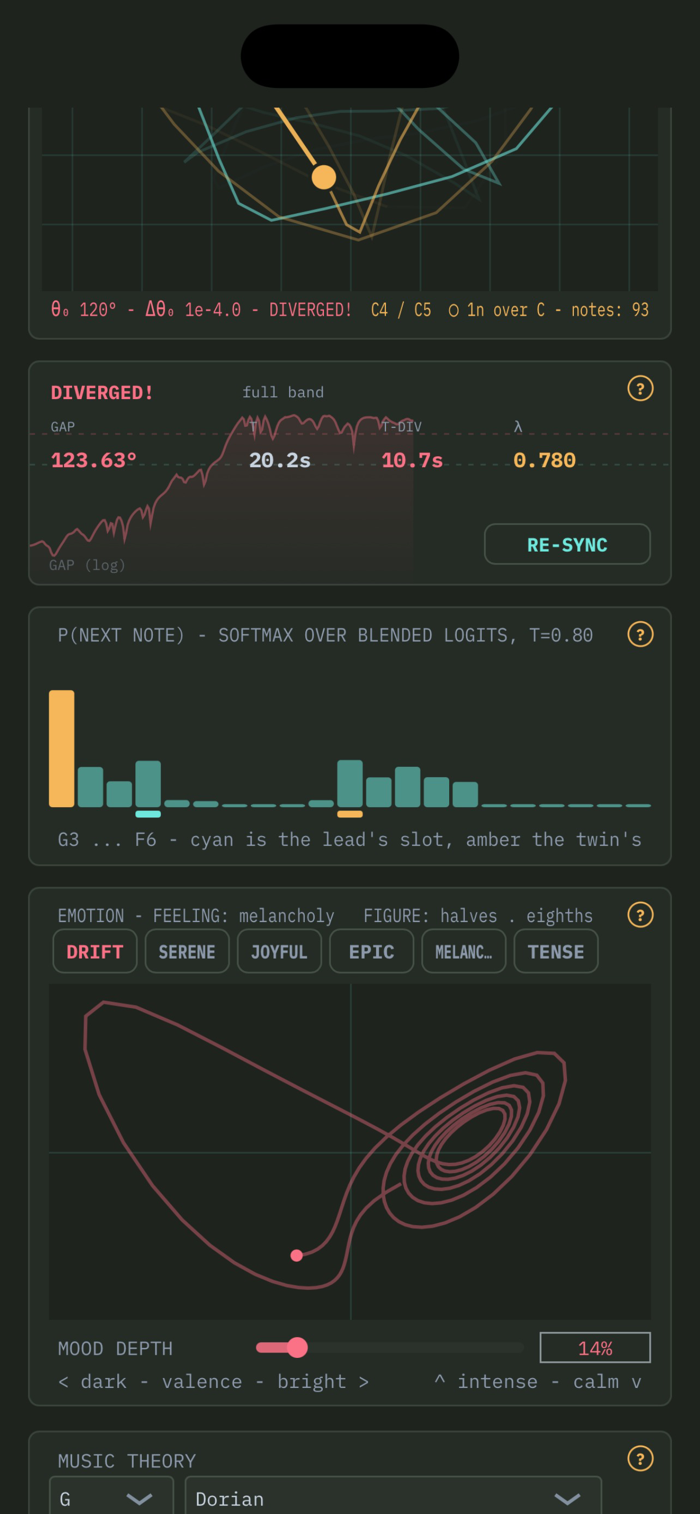
Watch it happen: the gap is plotted live on a log scale with the running
Lyapunov exponent beside it, so you can see the divergence coming before you
hear it.
DRAG THE RIG
Pull the pendulum round to set the release angle and both twins let go
again, from anywhere in the piece. Release it inside about 79 degrees and the
motion stays regular, the twins never part, and the solo holds indefinitely —
chaos is a regime, not a law, and the scope draws you that boundary while you
drag. Outside it, the twin offset sets how long the solo lasts before chaos
takes over, though only logarithmically: each extra decimal place buys about
the same few seconds again.
CHAOS PROPOSES, A POLICY DISPOSES
The far bob's position proposes a region of pitches rather than one note. A
Markov policy then decides what actually plays, learning from its own output
and rewarding intervals that sound consonant. Slide BLEND to choose who wins.
WHAT YOU GET
• 26 scales — major and minor modes, pentatonics, blues, whole tone,
harmonic and melodic minor, altered, both octatonics, and folk scales
from Japan, China, Egypt, Spain, Arabia and Hungary
• 8 accompaniment styles — chaos grooves, jazz comping with walking bass,
stride piano, Alberti bass, classical, arpeggios, oriental rolls, ambient
• Four sampled instruments — grand piano, koto, zither and shakuhachi —
plus synthesised voices: soft piano, glass, strings, FM bell, AM organ,
pluck, fat saw and more
• 6 moods on a valence/arousal plane, from serene to tense, driving chord
quality, register, tempo and note length
• Expression built into the physics: ring, note bend, grace notes, and
octave doubling called by the second bob
• Live displays — the rig itself, the divergence chart, the note-probability
distribution the engine samples from, and the mood point
• Record a take and export it as a standard MIDI file to the Files app —
lead, twin, chords and bass on separate tracks
TWO AUDIO UNITS
Pendulums ships as an instrument AUv3 and as a MIDI processor AUv3, so it can
either play its own sounds or sequence any other instrument in your host.
Lead, twin, chords and bass each send on their own MIDI channel, so one
instance can drive four different instruments. Both Audio Units follow your
host's transport and tempo — hit play in AUM, GarageBand, Logic, Cubasis or
Zenbeats and it locks to the grid, on the bar line, even if you start mid-bar.
One install registers both.
CREDITS
Sampled piano: Salamander Grand Piano by Alexander Holm (CC BY 3.0).
Koto and shakuhachi: FluidR3 GM soundfont by Frank Wen (MIT). Zither: đàn tranh from
the Versilian Community Sample Library (CC0).


 +100宝石


 分享
分享










用户评价
立即分享产品体验
你的真实体验,为其他用户提供宝贵参考
💎 分享获得宝石
【分享体验 · 获得宝石 · 增加抽奖机会】
将你的产品体验分享给更多人,获得更多宝石奖励!
💎 宝石奖励
每当有用户点击你分享的体验链接并点赞"对我有用",你将获得:
🔗 如何分享
复制下方专属链接,分享到社交媒体、群聊或好友:
💡 小贴士
分享时可以添加你的个人推荐语,让更多人了解这款产品的优点!
示例分享文案:
"推荐一款我最近体验过的应用,界面设计很精美,功能也很实用。有兴趣的朋友可以看看我的详细体验评价~"
关注 Mergeek 公众号
领奖遇到问题?联系小门助手